



Singapore3
Strategic Water Resources Management
Singapore's water resources management system is globally leading case study and already reached very advanced levels in water engineering (and achieving a remarkable success story through its Four National Taps and sophisticated water systems and projects), despite the scarcity of its marine, surface, and groundwater resources, we believe that the story has not ended there. Rather, it is poised to continue and transition into what we call Strategic Water Resources Management, or Singapore3 Project. through three tracks:
- Strategic Production and Storage: This involves the exploitation and development of important and sustainable resources (especially marine and groundwater) to increase innovative marine and groundwater strategic production and storage. This project aims to increase production by approximately 1 million cubic meters of water daily through innovative and direct desalination systems. It also expands surface storage and activates groundwater through the concept of strategic marine reservoirs (or what we call reservoirs 33 and 35), adding a storage capacity of approximately 600 million to over one billion cubic meters of fresh water. This is equivalent to about 10 times the storage capacity of the current surface reservoir system (which comprises 17 reservoirs) This makes it capable of meeting needs for many years.
- Strategic Planning (Smart Hydraulic Use of Spaces): Water spaces such as surface reservoirs are considered underutilized and should, and indeed should, be utilized (unless there are environmental constraints such as the presence of aquatic organisms like fish). They can be utilized in a manner similar to the remarkable floating solar power plant project at Tengeh Reservoir. Furthermore, floating or stationary cities can be built on the surface of these reservoirs without affecting their function as water storage facilities.
-Strategic Modernization (Including Innovation and Technological Upgrade): This represents Singapore's approach to managing its water resources and encompasses systems for pumping, desalination, treatment, management, protection, digitalization, and artificial intelligence.
The methodology of Singapore3 project based on transforming Singapore's surrounding marine environment (north, east, and west) into a freshwater reservoir divided into Reservoir33 (or the internal reservoir, located within Singapore's geographical boundaries) and Reservoir35 (or the external reservoir, covering most of the Johor Strait and shared by Singapore and Malaysia).
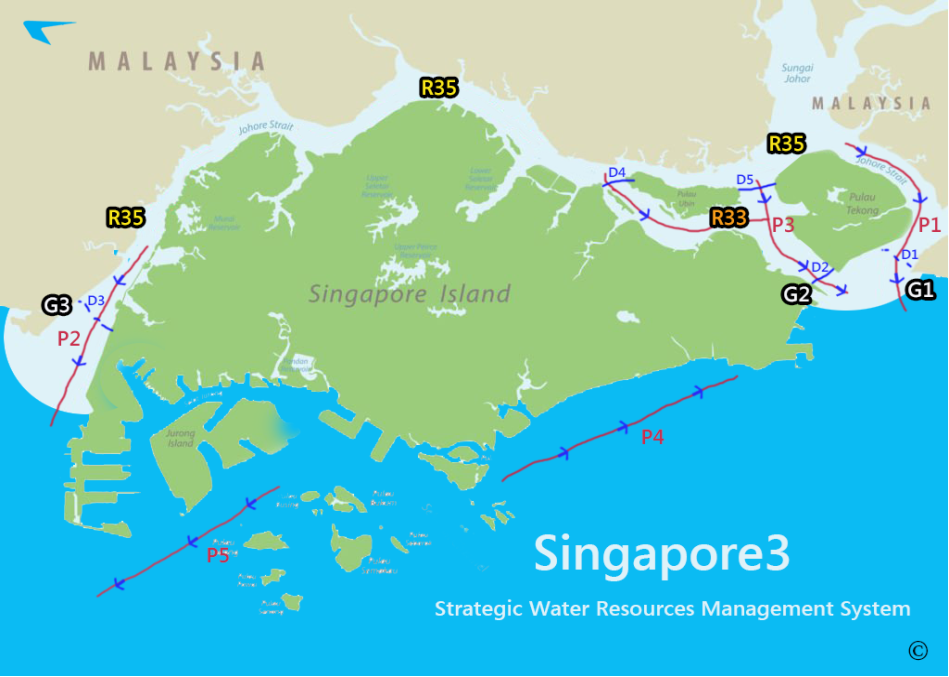
The project also incorporates several innovative technologies and systems, including:
- The P3 Paths System (Desalination, Drainage, and Defense system), with five proposed paths.
- The D3 Dams System (a cost-effective and rapid dam system), with five proposed dams (open or closed), which are optional.
- The G3 Gates System (an estuary and strait management system), with three proposed gates (With an innovative and open haloclinic® water Gates, ensuring freedom of flow and navigation).
The project aims to:
- Alleviate Singapore's water stress.
- Increase the role of important, sustainable, and non-traditional resources, such as marine and groundwater resources.
- Activating the role of strategic underground storage, especially in the eastern basin (with highly porous aquifers).
- Protect against and mitigate the problems of flooding, pollution, drought, salinity, and other environmental challenges.
- Increase the efficiency and effectiveness of the resource management system.
- Expand the area of land that can be utilized.
- Achieving long-term strategic goals.
- Achieving joint strategic management between Singapore and Malaysia of shared resources such as Reservoir 35.
- Achieving protection from specific marine hazards on reclaimed lands.
- Adding high economic, environmental, and social values.
Finally, we would like to point out that the project is a natural and logical extension of the current management system, so it complements and integrates with it very easily.