



Pascal3®

Pascal3: represents the innovative methodology and concept adopted by Technology3 in developing assisted-flow systems/technologies known as TransFission (including the Piston3 technology), which rely primarily on Pascal's Law:-
F = P * A
And the famous Pascal's barrel experiment:
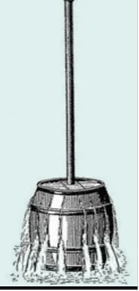
which is demonstrated through this recent experiment at the following link:
https://www.youtube.com/watch?v=EJHrr21UvY8
and reflects the immense magnitude of the force F (rather than the pressure P) that caused it to shatter. Even though pressure is often considered the underlying cause of this destruction (as many believe and prefer to think), the reality is that pressure is a value that increases with force—consistent with Pascal's Law, which also demonstrates the inverse relationship between pressure P and area A, as follows:
P=F/A
From this, we find that increasing the area leads to a decrease in pressure—not the other way around—whereas force increases as the area increases. Consequently, force is the primary driver in all cases and the factor behind any increase in pressure. There are two operational scenarios:
- The confined fluid scenario (closed piston):
In this case, the force (F) typically acts via displacement to reduce the area, thereby causing an increase in pressure.
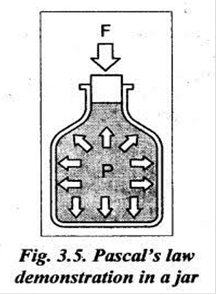
- Continuous flow state (pump and sustained flow):
Here, the pressure P generates flow forces F, which ensure the continuation of the process, as shown in the following model:
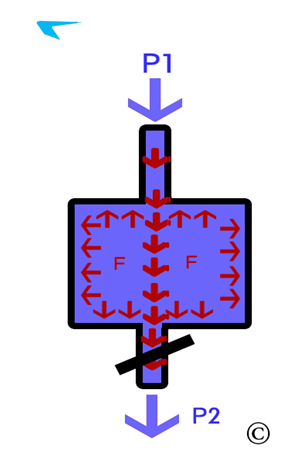
Three main types (or groups) of forces—referred to as "forces of flow"—can be distinguished, as follows:
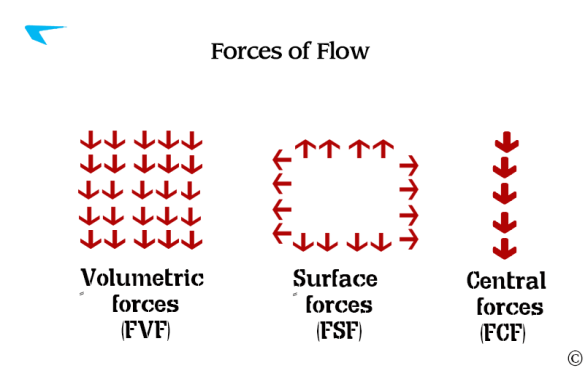
- Central flow forces (FCF): These represent the forces of the main flow stream; they are concentrated and powerful.
- Surface flow forces (FSF): These forces develop across large surface areas. They are calculated based on the surface area; consequently, they can yield high values as the area expands—values that may be significantly higher than the central forces that initiated them.
- Volumetric flow forces (FVF): These represent the resultant of the total flow forces directed within a specific volume. Calculated based on total volume, they yield extremely high values. A well-known example is the piston mechanism, capable of generating such immense volumetric forces; a simple, common example is the medical syringe plunger, which applies volumetric force to the liquid, ensuring the discharge of force from the needle tip.
Example:
Calculating the surface flow forces for a cylinder with a radius of 10 cm and a height of 10 cm, resulting from a pressure P (central force) of 5 bar.
Solution:
Total cylinder surface area = 1,256 cm²
Cylinder volume = 3,142 cm³
Central flow force (5 bar) = 50 N/cm²
Surface flow force (FSF) = 50 × 1,256 = 62,800 N.
This demonstrates the vast difference between the central (source) forces (FCF) and the surface (resultant) forces (FSF). Direction of Force direction:
Flow forces are classified according to their direction relative to the flow path—governed by the principle that the stronger force dictates (directs) the weaker one—as follows:
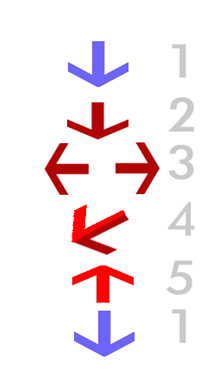
1- Primary forces: Representing the main sources (input and output).
2- Allied forces: Those directed in the same direction as the flow.
3- Reserve (neutral) forces: Those directed laterally (horizontally relative to the flow direction) to form surface (lateral) forces.
4- Oscillating (fluctuating) forces: Forces that alternate between the direction of the flow and the opposite direction (such as pumping forces acting against gravity).
5- Opposing (hostile) forces: Those directed against the flow (strongly resisting it and acting to halt it).
Piston:
It is the primary mechanism associated with Pascal's Law, particularly in the case of a confined fluid (closed piston):-
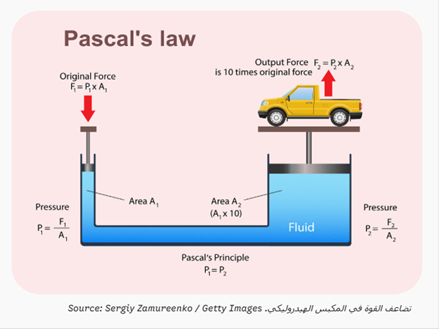
Important applications in our daily lives include:
• Hydraulic presses and lifts: Used in automotive workshops to lift heavy loads using minimal force.
• Hydraulic brakes: When the brake pedal is pressed, the fluid transmits pressure to larger brake cylinders at the wheels to stop the vehicle.
• Excavators and heavy machinery: These utilize hydraulic rams to generate immense lifting and digging forces.
Piston3:
One of the innovative methods within the Pascal3 methodology for a high-power, high-efficiency continuous-flow press (operating on the principle of force harvesting or redirection) is as follows:
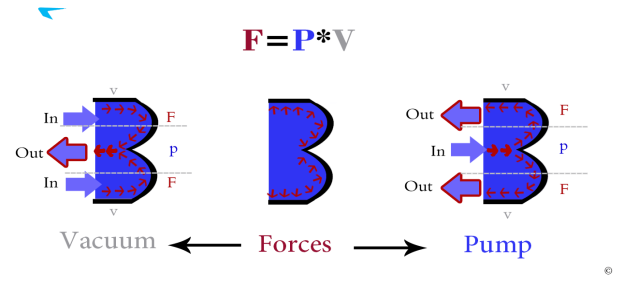
The "Piston3" technology relies on Pascal’s three parameters (Force *F*, Pressure *P*, and Area *V*). Its structure of 3—narrow at the center (Section P) and wide at the periphery (Section F)—satisfies the pressure and force equations derived from Pascal’s Law as follows:
- Pressure Equation (*P=F/V*): The technology constricts the area *V* facing the incoming flow at the center, thereby increasing the pressure *P* (harvesting Central Force/FCF).
- Force Equation (*F=PV*): The high pressure generated in the previous step is directed toward the periphery (harvesting Surface Force/FSF).
The result is a powerful, high-pressure, high-force flow known as "Forced Flow" (FF) or "Powered Flow" (PF). This enables the realization of the concept of "free" (flexible) force or flow—meaning it can achieve maximum velocity and torque.
Applications:
The Piston3 concept (technology) is utilized in several significant applications, including:
- The Volcano3 volcanic pumping (flow) system.
- The Gumper3 gravitational (free) pumping system.