



GearFST®

New transmission system
GearFST (also known as "BearFST" or "Transmitter3") is an innovative powerful transmission project of Technology3. Known as the Triple transmission(FST)F-Force, S-speed and T-torque system, it is characterized as a high-performance, high-power of (constrained-free) transmission system. It enables the realization of Technology3® concepts—such as "Free=Motion (FM)®"—and is suitable for motion applications requiring high torque, speed, and force, or achieving a balance between them. It comes in three main variants: the Square (Exponential) X2, the Multi Xi, and the galactic® Transmitter Xg. The GearFST system operates using innovative planetary and galactic® gear mechanisms and redefines the relationships between the three motion parameters (FST). It consists of a cylindrical gearbox with a central output shaft, featuring markings that indicate its type, power rating (X), and directional arrows, as shown in the following model:
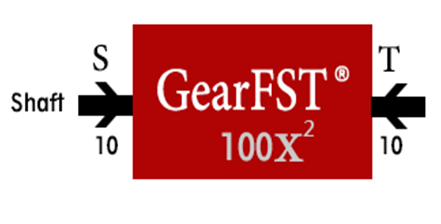
Which represents an exponential transmission X2 system with a 100X power, operating in two directions: the torque direction T (increasing torque 100-times while reducing speed 100-times) and the speed direction S (increasing speed 100-Times while reducing torque 100-times), as we will see in the following examples.
1- Square (Exponential) Transmitter - GearFST (X2):
It is a constrained transmission system governed by the inverse relationship between torque and speed (where an increase in one results in a decrease in the other). It is a "squared" system in which the torque and speed factors are equal; consequently, the power value (or transformation ratio)—denoted as X²—represents the square of the product of these equal torque and speed values. As shown in the previous figure, this value is 100 (implying torque = 10 and speed = 10). This means the transmission's power factor is 100: if side S is utilized, speed increases 100-fold while torque decreases 100-fold; conversely, if side T is utilized, torque increases 100-fold while speed decreases 100-fold. Examples include exponential transmissions with values such as 4, 9, 16, 25, 36, etc.; for instance, if the transmission value is 25, it implies torque (T) = 5 and speed (S) = 5. Its operation is further illustrated by the following example:
Example:
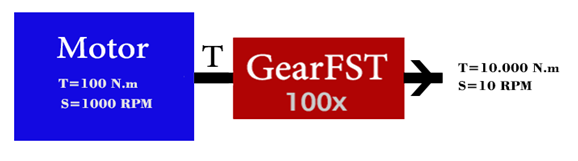
If we have a motor with a torque of 100 N·m and a speed of 1000 rpm, and we use the previously mentioned (exponential) transmission—which has a power factor of 100x—on the T-side, the result will be an increase in torque to T = 10,000 N·m and a decrease in speed to S = 10 rpm, as shown in the following figure:
If we reverse the direction of transmitter towards the speed side S, as shown in the following figure:
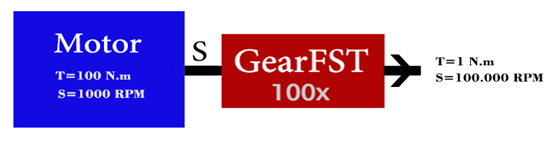
The result will be an increase in speed to S = 100,000 RPM, while the torque decreases to just T = 1 N·m.
The X2-Transmitter system is characterized by its ability to achieve significant results in power transmission, delivering either high torque (at the expense of speed) or high speed (at the expense of torque). This makes it suitable for applications requiring high torque and low speed—such as hoists—as well as those requiring high speed and low torque. For instance, a X2-Transmitter system with a 100:1 ratio can transform a modest manual input of approximately 10–15 N·m into a powerful output of 1,000–1,500 N·m—sufficient for various manual tasks like loosening bolts or lifting heavy loads—while conversely enabling high rotational speeds exceeding 100 revolutions per second.
2- Multi-Transmitter - GearFST (Xi):-
It is a multi-speed/multi-torque transmission system governed by the inverse relationship between torque and speed—where an increase in one results in a decrease in the other. In this system, the torque value corresponds to an equal number of speed levels; for instance, if the transmission's torque factor is T=10, it can accommodate 10 speed levels. These levels facilitate gradual transitions and smoother power transmission, as follows:
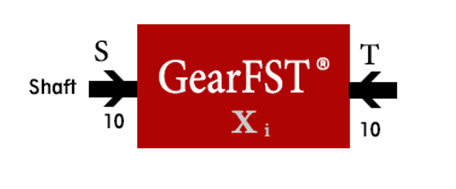
As shown in the figure, it is a dual-action transmission operating in two directions (the direction of motion and the direction of torque); its power capacity, X, is calculated based on the level using the following equation:
Xi=(((T+1)-S)/S)*T
For example, if we have a Xi-Transmitter with a torque coefficient of 10, the power for "Level 1"—designated as 10X1—can be calculated as follows:
X1=(((10+1)-1)/1)*10=100 (squared)
To calculate the capacity of the other levels, proceed as follows:
X2=(((10+1)-2)/2)*10=45
X3=(((10+1)-3)/3)*10=27
X4=(((10+1)-4)/4)*10=17.5
X5=(((10+1)-5)/5)*10=12
X6=(((10+1)-6)/6)*10=8.3
X7=(((10+1)-7)/7)*10=5.7
X8=(((10+1)-8)/8)*10=3.7
X9=(((10+1)-9)/9)*10=2.2
X10=(((10+1)-10)/10)*10=1(real)
We observe a gradient in the power of system X from 100 (exponential power) to 1 (actual power).
How does the system work?
Regarding torque (T): the process begins at level X1 and ends at level X10. Consequently, torque increases and speed decreases gradually until reaching level X10, where the system operates at its actual values. For example, if we use the motor from the previous example—with a speed of 1000 RPM and a torque of 100 N·m—the values (motion) will progress according to the aforementioned equations as follows:
The system starts at the first level (X1) with a high torque of 10,000 N·m and a speed of 10 RPM.
At the second level (X2): T = 100 × 45 = 4,500 N·m; S = 1000 / 45 = 22 RPM.
At the third level (X3): T = 100 × 27 = 2,700 N·m; S = 1000 / 27 = 37 RPM.
At the fourth level (X4): T = 100 × 17.5 = 1,750 N·m; S = 1000 / 17.5 = 57 RPM.
And so on, until...
Level X9: T = 100 × 2.2 = 220 N·m; S = 1000 / 2.2 = 454 RPM.
Reaching the tenth (actual) level, X10: T = 100 × 1 = 100 N·m; S = 1000 / 1 = 1000 RPM, where the system operates at its actual motion parameters.
Regarding speed (S): The system operates on an inverse scale, starting from the "actual" level (x10) and progressing to the "exponential" level (x1), as follows:
It begins at the tenth level, x10 (T=100/1=100 N·m, S=1000*1=1000 RPM) [Real Speed]
At the ninth level, x9 (T=100/2.2=45 N·m, S=1000*2.2=2200 RPM)
At the eighth level, x8 (T=100/3.7=27 N·m, S=1000*3.7=3700 RPM)
And so on, until...
Level two, x2 (T=100/45=2.2 N·m, S=1000*45=45,000 RPM)
Reaching the first (exponential) level, x1 (T=100/100=1 N·m, S=1000*100=100,000 RPM) [Exponential Speed].
Result: It is evident that the system operates using the same mechanism in both scenarios (whether regarding torque or speed)—specifically, starting with high torque and transitioning to high speed. This mechanism is ideal for many applications requiring high torque for startup and high speed for sustained operation.
3- Galactic Transmitter - GearFST (Xg):-
The Galactic Transmission System (GTS) is an innovative, unrestricted transmission system. It embodies the principle of free motion and decouples the inverse relationship between torque and speed, rendering them independent. Operating primarily in a single direction, it enables the simultaneous and independent transmission of torque and speed, as illustrated in the following figure:
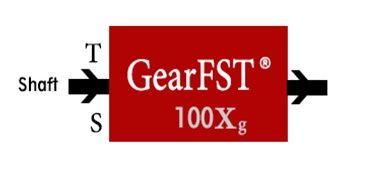
When used with the aforementioned motor—featuring a torque of 100 N·m and a speed of 1000 rpm—it achieves remarkable free-motion transmission results, as follows:
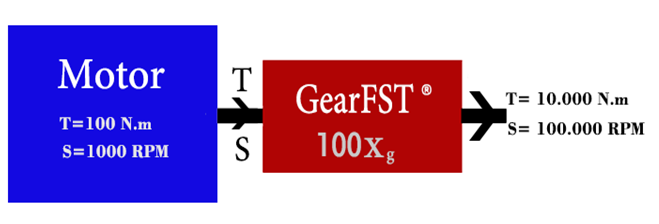
In addition to realizing the concept of free motion, its operating principle relies on other concepts—such as the range of forces or elastic forces—by balancing torque with the high speeds required for its operation. This makes it suitable for significant future projects, including renewable energy initiatives, water desalination and transport, jet propulsion (and space applications), and others.